Showing posts with label Matt Busby. Show all posts

Saturday, 6 February 2016

Tribute: The Flowers of Manchester.

On this day 60 years ago, a group of young men and officials of the most famous football club in England waited at the Munich-Riem airport for their Elizabethan aircraft to be deemed ready to brave the snow and freezing temperatures to carry them on their journey back to Manchester.

The club was returning from a successful match in Belgrade and had stopped in Munich to refuel.
The events that unfolded after the party boarded the plane for the last time would be engraved not only in the memories of those who lived through the terrible tragedy that would unfold, but also in the generations of supporters who would carry the light of their lost heroes forward so that no one would ever forget.

On the day of the tragedy seven players lost their lives in the plane crash, they were Roger Byrne, Tommy Taylor, Mark Jones, Eddie Colman, David Pegg, Liam Whelan and Geoff Bent. These were followed by Duncan Edwards, the greatest player of his and possibly later generations, who passed away a fortnight later in hospital after a brave fight. The heart of the Red Devils had been ripped out in the cruelest of ways. Matt Busby was left fighting for his life, not knowing the truth about his beloved Babes.

The club also lost Walter Crickmer, club secretary, Tom Curry, trainer and Bert Whalley, chief coach.

Many words have been written down the years detailing that fateful day, and I like millions of others have read most of the accounts, which have not only included biographies of the victims but also the stories of heroism by some of the survivors. Heroes like Harry Gregg who risked his own life to help the people trapped inside the burning wreckage.

There were many contributing factors that led to the crash. The biggest of which was the pressure on Busby to get his team back to England in time for their upcoming match on the coming Saturday. If only they had been given a little leeway on the return time they could have delayed the flight until the terrible weather conditions had cleared. Hindsight is a wonderful thing.

We should also remember the people who were left behind in Manchester to carry on and try to pick up the pieces. None more so than Jimmy Murphy, Busby's right-hand man. He was left with the unenviable task of rebuilding a side that had been decimated while Busby fought his way back to fitness.

Along with the survivors of the crash Harry Gregg, Bill Foulkes and the legend that is Bobby Charlton. Murphy begged, borrowed and almost stole players so that United could put out a team for their first match.

That match was at an emotionally charged Old Trafford in the FA Cup against Sheffield Wednesday. Charlton wasn't fit enough to play but Gregg and Foulkes took part in a game that United won 3-0. A poignant match programme had a blank team sheet where the names of the babes should have been.

It is a true testament to Murphy that he managed to take the side all the way back to Wembley for the FA Cup final. Even though we lost the match the result didn't really matter, the occasion did, as Matt Busby managed to join his team at the stadium where most of his fallen babes had played the season before.

Matt Busby and his boys were the pioneers of English football in Europe and it should never be forgotten that they died for a dream that Busby had of taking his team to the pinnacle of European football. A dream they would surely have realised if not in the same season then in the next.

It should also be remembered that the English FA were strongly against Manchester United entering the European Cup. Thıs began the uneasy tension that has been evident between the two ever since.

There is no doubt that with the talent in the team they would have matched and most probably surpassed the great Real Madrid. Already dominant in England, it was a formality that Europe would fall at their feet. The average age of the team was only 24, so it is safe to say they would have been together for many years ahead. Many of the players were England internationals and could easily have helped to lıft the World Cup before 1966.

Not only did United lose a team, but also the world of journalism lost it's valued colleagues, including: Frank Swift (News of the World), Henry Rose (Daily Express), Eric Thompson (Daily Mail), George Follows (Daily Herald), Archie Ledbrooke (Daily Mirror), Alf Clarke (Manchester Evening Chronicle), Tom Jackson (Manchester Evening News) and H D “Donny” Davies (Manchester Guardian).

As each year passes, it's only natural that people connected with the events surrounding Munich pass away, but what is important is that we should never forget that this one heartbreaking disaster is the bedrock of our truly great club. The tears for our lost Flowers of Manchester should never stop flowing and nor should people forget the legacy that Matt Busby and his Babes gave to the greatest club in the world and football.


They are the team that will never die. They are the Flowers of Manchester.

Thanks for reading.

Miles Dunton.

Thursday, 30 July 2015

George Best: The Boy from Belfast.


"It was a very simple team talk. All I used to say was 'Whenever possible, give the ball to George'" Sir Matt Busby.

In the final part of my tribute to the 'United Trinity', I have literally left the best till last, George Best. Over the years, thousands of words have filled hundreds of books, magazines and newspaper columns filling both the back and front pages with tales of his on and off field exploits some false but unfortunately the majority mostly true.

Born in Belfast, Northern Ireland in 1946 he arrived in Manchester at the age of 15 having been discovered by United scout Bob Bishop who informed manager Matt Busby that he had found a 'genius', but it nearly turned sour as after only a couple of days Best returned home to Belfast feeling homesick. He was eventually convinced to return to Manchester by Busby, the United coaches and his father.

In the 60's a youngster coming to a different city must have been formidable, especially for a teen with a strong Northern Irish accent and being the first time away from his family. However, Best was in safe hands at a club who were well used to looking after and developing young players.

Young George spent the next couple of years as an apprentice at Old Trafford and trained with players much larger than himself, but Busby informed all the coaches to let the slightly built youngster develop in his own way.

Over the next two years the Best had developed enough that Busby didn't want to wait any longer to unleash the boy wonder and in September 1963 Best was named as a reserve for the fixture against West Bromwich Albion at Old Trafford.

Famously, Best believed that he had only been chosen as an errand boy to carry the first team player's bags and to hand out the half-time tea, but at the pre-match luncheon Busby informed the shocked teenager that he would indeed be playing that day.

While other players in the dressing room were going through their pre-match rituals to ease their nerves Best was the epitome of calm as he sat browsing through the Matchday programme.

The lack of nerves was to become synonymous with George whether it was playing in front of packed grounds at home or abroad or coming up against brutes of defenders, he never showed any nerves and went about embarrassing full-backs up and down the country by twisting and turning his way around the pitch.

Best must have believed that he done enough to warrant a stay in the first team after the 1-0 victory over Albion but it wasn't to be and he had to wait another three months to earn a recall and he grabbed his chance with both hands, and feet, in a home 5-1 victory over Burnley in which he also scored the first of his 179 goals as a Red Devil. From that match, he never looked back and became a regular for almost the next decade.

That debut season he went on to make a total of 26 appearances, scoring 6 goals and there was something fresh about his play in which not only were the opposition mesmerised by his skills, but also the fans who had found a player they could rave about on the way to matches as well as on the way home. A new hero for a new era.

The next season, 1964/65, Best was instrumental in bringing the First Division title back to Old Trafford for the first time since 1957 as United pipped Leeds to the title on goal difference with Best contributing with 10 goals in 41 appearances, but more importantly it propelled United back into the European Cup competition and a chance for Best to display his talents abroad.

Best was enjoying his football playing alongside more experienced players, including Charlton, Foulkes, Law and Crerand not that he needed any help from his teammates as he would generally do his own stuff on the pitch as once he had the ball at his feet it was as if it didn't want to leave him.

George's first taste of European Cup football in the 1965/66 season came in the return leg against HJK Helsinki at home in the preliminary round. United easily won 6-0 with Best netting twice, but his status was catapulted into the stratosphere in the quarter-final 2nd leg against Benfica in Portugal.

United had won the first leg at home 3-2 and the return tie was in the balance that was until Best took the match by the scruff of the neck and turned in a performance of pure brilliance scoring twice in a 5-1 drubbing of the Portuguese champions.

The 19-year-old returned to Manchester on a different level and an instant hero. Having been dubbed the 5th Beatle by the media everybody wanted a piece of this new football genius. Many people have put this sudden rise in his status as the start of his off-field troubles as he seemed to appear more on the front pages than the back.

Unfortunately for both United and Best the season would finish on a downbeat note as it would end empty handed even though he had scored 17 times in 43 games. Best would also suffer a knee injury that kept him out of the crucial European Cup semi-final in which the reds lost out to Partizan Belgrade when they badly needed his goal scoring touch.

In the 1966/67 campaign success returned to United as they once again won the First Division with Best an ever present playing 45 games and contributing with 10 goals in all competitions. More importantly, it meant that United would once again have another chance of lifting the European cup.

The 1967/68 season would prove to be Best's most prolific in the red of United as he scored an incredible 32 goals in all competitions which included a massive 28 in the league, however it wasn't enough as local rivals Man City ran out champions by only 2 points.

The disappointment of not retaining the league would soon be tempered by the glory of being crowned the first English club to become European champions.

On the way to the final United had dispatched the mighty Real Madrid 4-3 on aggregate in the semi-final with George securing a 1-0 win at Old Trafford in the first leg. May 29th, 1968 at Wembley stadium Benfica were the team standing in the way of United winning the European Cup a decade after the tragedy of the Munich air disaster.

On an emotional night, Best and his teammates turned in a display that the previous Busby Babes would have been proud of as they beat the Portuguese 4-1 after extra time.

Of course Best scored on the night and the iconic image of him celebrating with his arm raised and socks rolled down will live forever in the memory of all true United fans.

Nobody would have guessed as the team danced along with Busby around the famous turf at Wembley that this would be the last silverware that Best and indeed United would win together. The future looked so bright, but it actually proved to be the pinnacle of success under the legendary manager.

That year George was also awarded the Ballon d'Or as had Law and Charlton earlier in the decade, the 'United Trinity'.

Following the dizzy height of that incredible night in 1968 Best would go on to make a total of 244 appearances, scoring exactly 100 more goals over the next six seasons.

His hair would grow longer, as would his beard, but his skills never waned, and of course, there were reports of his adventures every day in the press, but the fans didn't care as long as come match day his name was on the team sheet.

During those years Best started to spiral out of control off the field with reports of alcohol problems and missed training sessions.

It seemed that as hard as Matt Busby tried to take care of his star player the more outside influences were pulling him away from the safety of the club.

As United's fortunes dipped many speculated that things had to change at the club before it was too late and in 1969 Matt Busby passed on the managerial role to former player Wilf McGuinness.

In McGuinness' short lived time as manager Best did his utmost to turn the club's fortunes around by scoring 23 times, including a record 6 goals in an FA Cup tie against Northampton Town.

However, it all came to nothing and Busby returned as manager in 1970. By that time George was starting to misbehave on a regular basis and was fined by the club after missing a trip to London to take on Chelsea as he was busy elsewhere. Busby seemed to be totally fed up with Best's antics, but as hard as he tried he was powerless to keep him in check.

Frank O'Farrell was given the unenviable task of keeping Best on track in the 1971/72 season, but he was up to his old tricks by missing a whole week of training mid-season. Amid the problems he did score 26 goals in 53 games, it was turning into a conundrum for the club.

After Best again failed to turn up for club commitments, choosing instead to party in London, he was punished with suspension, a fine and transfer-listed.

After O'Farrell was replaced by Scot Tommy Docherty as the manager the situation between Best and United had gone beyond repair and George played his last game for the Reds in a loss to QPR at Loftus Road on New Years Day, 1974 having made 470 appearances and scoring 179 goals. That season United were relegated from the old First Division.

George, of course, played for the Northern Ireland national team representing his country 37 times, scoring only 9 goals, four of which came in one match.

It was a shame that he didn't have the chance to show off his talent on a World Cup stage as it would have made him, without question, the number one player in the history of the game, which is often given to Pele or Maradona.

It would be correct to say that Best fulfilled his early potential in football, however, due to circumstances far beyond anyone's control it didn't last. Upon leaving United in 1974 after 11 years at the top and at the prime age of 28, he became a roving player who plied his skill around the world including England, Scotland, Ireland, America, Australia and even Hong Kong. Wherever he played fans flocked to the stadiums as he still had the pulling power of a superstar.

After he retired from playing It seemed everybody wanted a piece of the United legend for his guaranteed popularity the controversy his fight with alcoholism would produce.

An example of this was the infamous live TV interview hosted by fellow Irishman Terry Wogan where the BBC disgustingly filled his dressing room with drinks and ended up being red-faced as the public sympathised with George's situation.

Towards the end of his life he worked as a football pundit on TV and fans enjoyed listening to his views and insights on his beloved Manchester United, however, he was visibly suffering with his addiction and in the end it got the better of him. He sadly passed away on November 25, 2005 aged only 59.

A minutes silence was adhered to around every ground in the Premier League and the United match at Old Trafford following his death was fittingly against WBA the team who George had made his debut against all those years ago as a skinny teenager.

What George Best gave the watching thousands each match will never be equaled, no matter how hard other players try. He was a one-off, a man blessed with the attributes that other players can only dream of.

If only there had been somebody to put their arm around his shoulder and not a hand in his pocket, maybe, just maybe he would still be with us now instead of succumbing to the dreadful disease that alcoholism brings.

It's a almost a decade since George left us, but one thing is for sure he will be forever remembered by all fans all over the world as simply the Best.

George Best a true footballing genius.

Miles Dunton.

Sunday, 5 July 2015

Manchester United Legends: Denis Law.


Spinning away from goal, right arm extended upwards with the cuff of his sleeve tightly gripped in his hand and with one finger pointing to the heavens is a sight that is forever embedded in the memory.

The man in whose goal celebration has been immortalised in statues gracing the Theatre of Dreams is none other than the King of The Stretford End, Denis Law.

As he celebrates the milestone of his 80th birthday and almost 60 years since the likeable Scot signed for Manchester United, in doing so cementing his status as a United legend, I take a look back at his time at United.

Charlton, Law and Best three names that will be forever synonymous with Old Trafford as the United Trinity all played under the guidance of Sir Matt Busby during the heady sixties a decade in which saw the glory days return to Manchester United and breathe fresh life into the club that had suffered from disaster in 1958.

Law joined United on the 12th of July 1962 at the age of 22 signing for the Red Devils from Torino of Italy for a British transfer record fee of £115,000. However, if Bill Shankly had gotten his way three years earlier Law could have been a kop hero instead of the Stretford End King.

In 1959 Shankly, who had been the manager of Law's first professional club Huddersfield, left to take over as manager of Liverpool and the first player he wanted to sign was his fellow countryman, but the problem was that Liverpool simply couldn't afford the transfer fee and the next year Law signed for Manchester City for £55,000 which back then was a British transfer record.

Matt Busby had tried to buy Law when he was a teenager offering £10,000 which at the time was a substantial amount of money for a young player, but Huddersfield rejected the offer. Busby tried once more to acquire the striker before he signed for local rivals City.

He only played for City for a season and helped them avoid relegation by netting a total of 21 goals which doesn't include the six goals he scored against Luton Town at Kenilworth Road in the FA Cup as the match was abandoned with twenty minutes left due to a waterlogged pitch and his goals didn't count. To make matters worse, City lost the replay 1-3.

The following summer the boy from Aberdeen decided to showcase his talents abroad and signed for Torino. His time there seemed to be a mixed bag from the start with Inter claiming that he had agreed to sign for them, a car accident, that almost killed his friend and colleague Joe Baker, from which Law escaped from unhurt and the style of play in Italian football at that time hardly suited British strikers due to the ultra-defensive mentality that limited goalscoring chances. However, Law was voted the best foreign player in Italy during his time there.

The straw that broke the camel's back for Law came in one match against Napoli when he was sent off and after the match discovered that unbelievably the referee had been told to do so by his own Torino manager as he had taken a throw in when instructed not to. Law had had enough and at the third time of asking Matt Busby finally got his man.

His love affair with Manchester United had begun and it was to be an affair which would have incredible highs, including winning and scoring in the FA Cup final against Leicester City in 1963, two first division titles in 1965 and 1967 and being honoured with the prestigious Ballon d'Or in 1964.

In his first season as a Red Devil, he ended up scoring a total of 29 goals which included a strike on his debut against West Bromwich Albion at Old Trafford.

Over the next decade, he would go on to play just over 400 games and score a total of 237 goals a brilliant return considering he endured knee problems on a regular basis. His most prolific season was 1963/64 in which he scored 46 goals in all competitions.

He was also a target of referees and the FA, following comments he had made concerning a certain referees professionalism, receiving some outrageous suspensions one of which was in the 1963/64 season a 28 day ban after a red card against Aston Villa which severely dented United's chances of winning the league. They finished second behind his old manager Bill Shankly's Liverpool.

The following season he helped United to the first division championship by netting 39 times in all competitions. That season he scored 28 league goals which were crucial as United and Leeds ended the campaign on the same amount of points, but United had a superior goal difference of 19 goals.

His style of play and knack of scoring both incredibly athletic and poacher like goals endeared him to the United faithful and it quickly earned him nicknames such as 'The Lawman' and the one that stuck 'The King of the Stretford End'.

There was no better sight than to see Law leaping above the defenders to head the ball in or ghost in between defenders to slot the ball home, but the most famous had to be the overhead kick that had all the children trying to copy in the park. Above all else it was his fearless character that won him the biggest respect among the fans.

In no way hugely built compared to the defenders of that time he was harried and bullied as he led the front line, but his never say die attitude and the experience he received while at Torino stood him in good stead.

His time at United also came with some lows. One of those was the incident in 1966 when he asked Matt Busby for a pay rise that made his manager see red leading to this famous Busby quote: "No player will hold this club to ransom, no player".

His second championship medal came in the 1966/67 season when he once again ended up the leading goalscorer for United with 23 in the league.

Busby had built another great team and the world sat up and took notice, and with George Best in the side they were also elevated to 'pop star' level. Along with Law's goalscoring skills, they had the likes of Herd, Crerand, Stiles, Foulkes, Dunne, Stepney and of course Bobby Charlton. The side played the United way, entertaining, but at the same time lethal.

The low ebb of his time at United had to be when Law, who had struggled for a while with a knee problem, would miss out on the clubs' biggest night in their illustrious history. It was May 1968 and as his teammates were defeating Benfica at Wembley to become the first English side to lift the European Cup as they were doing so Law was watching the match from his hospital bed following surgery to his knee.

It's difficult to imagine what was going through his mind at that joyous time for the club, but it must have been a bittersweet night for The King. However, you never saw him without a grin on his face and his brilliant sense of humour.

As the decade came to a close, it was time for a change in management and the reigns passed briefly from Matt Busby to former Busby Babe Wilf McGuinness in 1969 a move that didn't sit well with some of the experienced players at the club. Law missed most of that season with an injury and United finished in a miserable eighth spot.

Busby came back for a short time until the appointment of Irishman Frank O'Farrell in 1971 but by then the writing was on the wall for most of the players, including Law, who had been transfer listed, but surprisingly no buyers came calling. When O'Farrell was fired it was Law who put forward the name of fellow Scot Tommy Docherty as his replacement. Docherty had been Law's Scottish national coach.

Law made a scoring debut for Scotland in 1958 against Wales and went on to earn a total of 55 caps and score 30 goals until his last game in 1974. Ironically, it was Matt Busby, who handed Law his first international game while he was the Scottish manager for a short time in the winter of 1958.

Law played his last match for United against Norwich City in 1973 and ended his illustrious eleven-year association with Manchester United by swapping red for blue with a free transfer to Manchester City.

Law only played one season for City and it started with another debut goal, but it's how it ended that would become synonymous with his time there.

Following his infamous back-heeled goal against United at Old Trafford he left the pitch, head down and visibly distraught by the scenario that had been created. The fact is in the end his goal for City that beat his beloved United had no bearing on United's relegation as they were doomed anyway.

Following his retirement from the game in 1974 he made use of his bubbly character and knowledge of the game by joining the media, mainly radio to start with, to share his wisdom on all things United.

He was honoured with a special section at the Old Trafford museum commemorating his 50-year association with the Red Devils.

At 80 he still lives in the Manchester area and can be seen regularly at United charitable events and matches. He married his wife Diana in 1962 and has five children. He revealed that he had been diagnosed with prostate cancer back in 2003. Two years later in 2005 he was at the bedside of fellow legend George Best when he passed away.

Having had the honour of meeting Denis Law he is nothing short of a true gentleman sparing the time to reminisce about his career and thoughts on United past and present. Although the encounter was all too short, he left a lasting impression on me and his love for the game is contagious.

He has been honoured with the appointment of CBE for his services to football and charities.

A legend in the true sense of the word.

Thanks Denis.

Miles Dunton.

Wednesday, 29 April 2015

Manchester United Legends: Sir Bobby Charlton.


With probably the most famous comb over hairstyle in the history of sport, Bobby Charlton waved his last goodbye to the faithful Manchester United fans in his final match against Chelsea at Stamford Bridge, on the 28th April 1973.

The fact that United lost the match is neither here nor there as the fans had only come to witness the final 90 minutes of a player who had literally given his all for the Red Devils over nearly twenty years of loyal service.

Brought to Old Trafford as a 15 year-old youth in 1953 after being spotted playing for East Northumberland schools by Manchester United chief scout Joe Armstrong Charlton was to blossom under the guidance of Matt Busby and became part of the famous Busby Babes.

He was handed his first taste of playing for the first team in his debut against his namesake team Charlton Athletic in October 1956. The match was a huge success for Charlton as he scored a double in a 4-2 win at Old Trafford.

A legend was born. He would go on to score a total of 12 goals in his debut season, which included a hat-trick against Charlton in the return match.

That was the season that United first entered the European Cup competition in which they would reach the semi-finals only to lose against holders Real Madrid. Charlton did manage to get a goal in the second leg 2-2 draw, but it wasn't enough on the night.

It would not be until the following season, 1957-58, that he would become a regular among the greatest English team of that time and many believe of all time.

Playing alongside the likes of Duncan Edwards, Roger Byrne, Tommy Taylor, Eddie Coleman and the rest of the Busby Babe Champions.

That season saw United defending their League Championship crown and once again involved in the prestigious European Cup.

United were on the verge of a possible treble of League, European Cup and FA Cup and a young Bobby Charlton was a part of a team entertaining fans not only in England but also all over Europe. The team was young enough to be at the top for a long time to come until disaster struck.

February 6th, 1958 the heart of Manchester United was ripped out on an icy airstrip in Munich, Germany. Charlton was among the few survivors of the crash that took the lives of young men who were not only his colleagues but also his closest friends.

Charlton was kept in hospital after the crash, but thankfully only received minor injuries and was able to return home to Manchester to help in the rebuilding of a team alongside assistant manager Jimmy Murphy.

However, not only had the light been distinguished in a club but also in the eyes of Charlton, who seemed to be deeply affected by the loss of his friends, a light that wouldn't return even in the brightest moments of his footballing career.

The difficult season ended empty handed for the gallant reds, although they did somehow manage to reach the final of the FA Cup with a side which included four survivors from the disaster Charlton, Gregg, Viollet and Foulkes. A nation willed them on to win, but it was Bolton Wanderers who hadn't read the script and ended up winning the cup 2-0. In many people's hearts the real winners were Manchester United.

The phoenix rising from the ashes had begun with Busby re-building his team this time based around Charlton. New players would be signed among them a certain Denis Law, but it wasn't until 1963 that United tasted their next success when they beat Leicester City in the FA Cup final at Wembley 3-1.

This showed that United was on the way back and along with new players arriving like Crerand, Stiles, Herd and a certain young shy teenager from Belfast who would be part of the trinity that would bring the glory days back to United, George Best.

The end of the 1964-65 saw United crowned as First Division champions in a season in which Charlton scored 18 goals in all competitions. He only managed 10 goals in the league but they were important as United beat Leeds United to the title on goal difference.

It also pointedly meant that they would return to the competition, which must have had brought up mixed feelings for Charlton, the European Cup.

Having beaten Benfica 5-1 away with the match that made Best an 'El Beatle' United lost out to Partizan Belgrade in the semi final, a step too far too soon.

The publicity that Best was receiving from the media didn't sit too well with Charlton, whose lifestyle couldn't have been any different. Married to Norma and with two daughters he was known as the quintessential family man.

Not able to retain the title United ended the season empty handed, but had built a reputation as a free flowing attacking side with a hard centre reminiscent of the Busby teams of the past.

On the international front Charlton had represented England at all levels from schoolboy level right through to full international where he played 106 times netting 49 times.

He was an integral part of Sir Alf Ramsey's 1966 World Cup winning team as they defeated West Germany in the final at Wembley 4-2.

Charlton didn't manage to find the net in the final, but it was his goals against Portugal in the semi-final that got England into the final. He would go on to become the only England player to be included in four World Cup squads.

Charlton was instrumental again as he scored another 18 goals in the following season as he helped the Red Devils to win back the First Division championship. This success paved the way for another attempt at the European Cup.

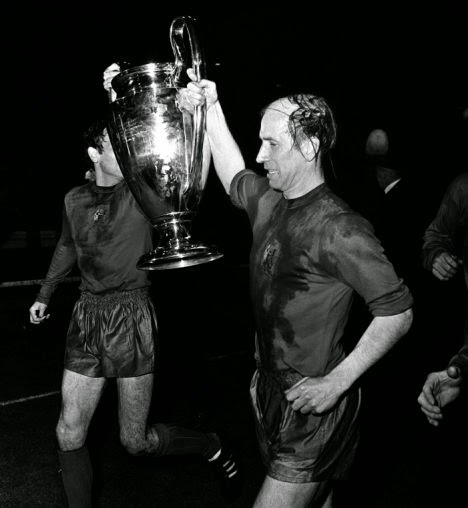
29th May 1968, Wembley stadium. No doubt the greatest night in Bobby Charlton's illustrious Manchester United career as the Red Devils beat Benfica 4-1 on home soil to lift the European Cup ten years after the Munich air disaster.

A double from Charlton, his first in the competition that season, helped to overcome the Portuguese and he had the great honour of being the first United player to lift the magnificent European trophy. The victory was the first win for an English side, which was fitting as it was Busby who fought so hard to be involved over a decade before.

One image from that wonderful night which sticks long in the memory was when Charlton and Matt Busby hugged down on the touch line. I guarantee their thoughts were with lost friends in that one moment of emotion among many.


That famous triumph would turn out to be Bobby Charlton's last piece of silverware for United as over the next few seasons things wouldn't turn out exactly as planned.

He would continue to play for his beloved club even though times were changing. Something else that was also changing was the United management.

Wilf McGuinness, who had signed for United on the same day as Charlton, was given the impossible task of taking over the reigns from the irreplaceable Matt Busby. It turned out to be a poison chalice for McGuinness, who struggled to win over the bigger personalities in the dressing room, Charlton included.

In 1970, after only one season Busby came back to try and steady a quickly sinking ship. One season later, Irishman Frank O'Farrell was given the chance to bring the good times back, but he also only lasted one season.

United's struggle was also reflected in Charlton's goal tally as he only managed 29 goals in all competitions during seasons 1968-69 to 70-71. There were also rumours of unrest in the United camp with a number of players not communicating with each other.

The writing was on the wall for many players, but it wasn't until the appointment of Tommy Docherty, a tough-talking no-nonsense Scot that would signal the end of the road for Charlton.

Docherty arrived in 1972 and immediately set out his stall bringing in younger players to replace the old timers. Bobby Charlton eventually bowed out as a United player at the end of the 1972-73 season, having come to United as a 15 year-old in 1953.

In that time he made a total of 758 appearances, only recently surpassed by Ryan Giggs, and scored an impressive 249 goals. The last of those came in a 2-0 win at Southampton in March 1973.

Upon retiring from playing he did venture into management with Preston North End, but that was short lived and he also tried his hand in business with a travel agency but the pull of United was too hard for him to ignore.

His adoration for his beloved Manchester United has seen his association with the club continue to the present day mainly in a director capacity. He was instrumental in bringing Sir Alex Ferguson to the club for that alone we should be grateful.

He can still be seen at all the games involving United home and away. He is also recognized all over the world and his name is indelibly linked with Old Trafford, after all it was Charlton who first called the stadium 'The Theatre of Dreams'.

No one encompasses United like this man. Although not originally from Manchester he has to be regarded now as a son of this great city.

In 2016 Charlton had two great honours bestowed upon him. The first was the renaming of the South Stand at Old Trafford, and the second was UEFA's Order of Merit in recognition of his lifelong devotion to football.

Thank you, Sir Bobby.

Miles Dunton.

Friday, 6 February 2015

Munich '58: The Flowers of Manchester.

On this day 57 years ago a group of young men and officials of the most famous football club in England were waiting at Munich-Riem airport for their Elizabethan aircraft to be deemed ready to brave the snow and freezing temperatures to carry them on their journey back to Manchester.


The club were returning from a successful match in Belgrade and had stopped in Munich to refuel.
The events that unfolded after the party boarded the plane for the last time would be engraved not only in the memories of those who lived through the terrible tragedy that would unfold, but also in the generations of supporters who would carry the light of their lost heroes forward so that no one would ever forget.

On the day of the tragedy seven players lost their lives in the plane crash, they were Roger Byrne, Tommy Taylor, Mark Jones, Eddie Colman, David Pegg, Liam Whelan and Geoff Bent these were followed by Duncan Edwards, the greatest player of his and possibly later generations, who passed away days later in hospital after a brave fight. The heart of the Red Devils had been ripped out in the cruelest of ways. Matt Busby was left fighting for his life, not knowing the truth about his beloved Babes.

The club also lost Walter Crickmer, club secretary, Tom Curry, trainer and Bert Whalley, chief coach.

Many words have been written down the years detailing that fateful day and I like millions of others have read most of the accounts, which have not only included biographies of the victims but also the stories of heroism by some of the survivors. Heroes like Harry Gregg who risked his own life to help the people trapped in the wreckage.

There were many contributing factors that led to the crash the biggest of which was the pressure on Busby to get his team back to England in time for their upcoming match on the coming Saturday. If only they had been given a little leeway on the return time they could have delayed the flight until the terrible weather conditions had cleared. Hindsight is a wonderful thing.

We should also remember the people who were left behind to carry on and try to pick up the pieces. None more so than Jimmy Murphy, Busby's right hand man. He was left with the unenviable task of rebuilding a side that had been decimated while Busby fought his way back to full fitness.

Murphy & Busby.
Along with the survivors of the crash Harry Gregg, Bill Foulkes and the legend that is Bobby Charlton. Murphy begged, borrowed and almost stole players so that United could put out a team for their first match.

The match was at an emotionally charged Old Trafford in the FA Cup against Sheffield Wednesday. Charlton wasn't fit enough to play but Gregg and Foulkes took part in a match that United won 3-0. A poignant match programme had a blank team sheet where the names of the babes should have been.

It is a true testament to the man that he managed to take the side all the way back to Wembley for the FA Cup final. Even though we lost the match the result didn't really matter, the occasion did, as Matt Busby managed to join his team at the stadium where most of his fallen babes had played the season before.

Matt Busby and his boys were the pioneers of English teams in Europe, it should never be forgotten that they died for a dream that Busby had of taking his team to the pinnacle of European football. A dream they would surely have realised if not in the same season then in the next.

It should also be remembered that the English FA was strongly against Manchester United entering the European Cup beginning the uneasy tension that has been evident between the two ever since.

There is no doubt that with the talent in the team they would have matched and most probably surpassed the great Real Madrid. Already dominant in England it was a formality that Europe would fall at their feet. The average age of the team was only 24, so it is safe to say they would have been together for many years ahead. Many of the players were England internationals and could easily have helped to win the World Cup before 1966.

Not only did United lose a team but also the world of journalism lost it's valued colleagues including: Frank Swift (News of the World), Henry Rose (Daily Express), Eric Thompson (Daily Mail), George Follows (Daily Herald), Archie Ledbrooke (Daily Mirror), Alf Clarke (Manchester Evening Chronicle), Tom Jackson (Manchester Evening News) and H D “Donny” Davies (Manchester Guardian).

As each year passes it's only natural that people connected with the events surrounding Munich pass away, but what is important is that we should never forget that this one heartbreaking disaster is the bedrock of our truly great club. The tears for our lost Flowers of Manchester should never stop flowing and nor should people forget the legacy that Matt Busby and his Babes gave to the greatest team in the world and football.


They are the team that will never die.

Miles Dunton.